
Equality cannot exist without self-responsibility?
A reflection inspired by Nietzsche, Plato, and the ancient Greek idea of leadership

I recently watched a video discussing Nietzsche’s Beyond Good and Evil.
It concluded with a striking sentence:
“Equality cannot exist without self-responsibility.”
At first glance, this sounds reasonable, even noble.
But if taken seriously, does it not quietly undermine the very idea of equality itself?
Because the uncomfortable truth, one we often refuse to face, is that human beings do not operate at the same level of consciousness, discipline, or inner development.
Some cultivate responsibility.
Others avoid it.
Some use opportunities.
Others squander them.
Under these conditions, absolute equality becomes impossible.
Everything depends on what we mean by “equality.”
Equality of opportunity?
If this is the goal, then responsibility is indeed essential.
Opportunities can only bear fruit when individuals are willing to act, sacrifice, and grow.
But even then, outcomes will differ.
Absolute equality?
If equality means identical results for everyone, it inevitably conflicts with personal responsibility, freedom, and the diversity of human character.
A society cannot simultaneously demand identical outcomes and individual accountability.
One principle cancels the other.
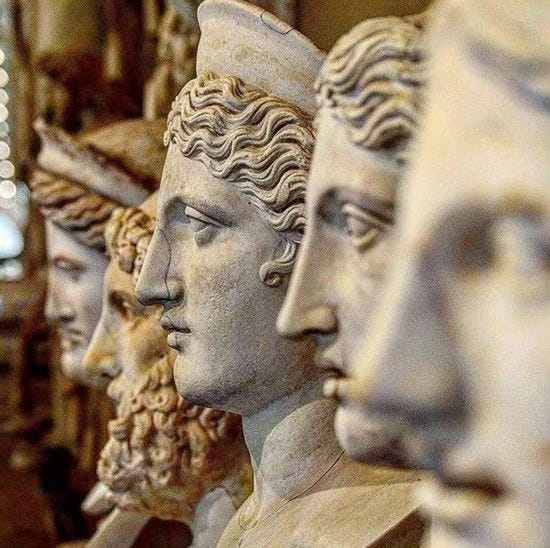
The Real Problem: Who Holds the steering wheel?
The deeper issue is not equality itself, but authority.
Who guides society?
Who sets direction?
Who shapes the narrative?
If those at the helm are truly excellent, in the classical sense, justice becomes possible, even if equality does not.
In Greek thought, “excellent” (ἄριστος) is not an elitist label but the superlative of agathos (good):
agathos → ameinōn → aristos
good → better → best
Justice, in this framework, means each person receives what is appropriate — not what is identical.
Not equal.
Proportionate.
But the term agathon carries a far deeper meaning than moral goodness. In classical philosophy it can describe not only a virtuous person, but the very order of the cosmos itself, the ultimate principle of intelligibility and harmony.
To call someone “good” in this sense is not merely to praise their behavior, but to suggest alignment with a universal order. The “best” human being, therefore, is not ‘‘superior’’ to others, but one who most fully embodies that order, a truly cosmic human rather than a merely social one.
Ancient Greek thinkers often treated the Good as something overflowing, generative, and life-giving. One traditional interpretation connects agathon with the idea of abundance or overflowing movement, that which pours forth into existence rather than remaining static.
Thus excellence was understood not as privilege, but as participation in the deepest structure of reality itself.
Plato’s Cave and the Makers of Shadows
Plato’s Allegory of the Cave describes prisoners chained in darkness, mistaking shadows for reality.
If one escapes and sees the sunlight, knowledge, truth, he initially suffers, then understands.
If he returns to liberate the others, they mock or attack him.
But Plato also identifies the source of the shadows: the manipulators behind the prisoners, projecting illusions.
In modern terms, these “shadow-makers” could correspond to mass media, propaganda systems, or any apparatus that manufactures public perception.
An obvious question follows:
How can we ensure that those in power are truly excellent rather than merely ambitious or manipulative?
How can corruption be prevented?
I do not claim to have a definitive answer.
But history offers a compelling example: the ancient Greek Mysteries.
The Mysteries as a School of Leaders
Those initiated into the Mysteries were not merely religious participants.
They were considered individuals transformed, capable of acting responsibly in society as artists, priests, soldiers, philosophers, or rulers.
True leadership required inner transformation first.
Self-knowledge.
Moral refinement.
Contact with deeper realities.
This was the essence of Greek paideia, education not as information transfer, but as the formation of character.
Its culmination, for those capable, was initiation.
In effect, the system aimed to produce leaders, heroes, and free minds.
The good became virtuous.
The virtuous became excellent.
The mediocre improved.
Even the harmful were restrained, or removed from civic influence.
Today, the pattern often appears reversed.
Modern political systems rarely require philosophical depth or moral training.
Success depends more on communication skills, financial backing, and demagogic talent.
As a result, individuals of genuine wisdom or integrity seldom reach positions of power and when they do, they are often neutralized.
History offers many examples of such figures.
Could a Modern “Initiatory” System Exist?
A contemporary framework for preparing leaders might include:
Ethical and philosophical education rooted in classical wisdom and self-knowledge
Character trials to test integrity and selflessness
Practical training in justice, responsibility, and governance
Protection from corrupting influences
But a difficult question arises:
Who would create such a system and who would guarantee its integrity?
Especially in an age where authority derives legitimacy from a mass public that is itself shaped by the same mechanisms of manipulation.
Are We Ready?
Perhaps not.
Running a complex democratic system already strains our collective maturity.
Sophisticated institutions require equally sophisticated citizens.
Fine garments require skilled wearers.
This brings us back to the original statement:
“Equality cannot exist without self-responsibility.”
The deeper problem is not whether the statement is true, but that it treats a symptom as a cause.
Responsibility itself is not spontaneously generated.
It emerges from culture, education, example, and leadership.
Without structures that cultivate responsibility, demanding it from individuals becomes circular, even hypocritical.
Thus society remains trapped in a loop:
Lack of responsibility undermines equality
Failed equality reinforces irresponsibility
The system reproduces itself
Meaningful change likely cannot emerge from the existing structures that perpetuate the current condition.
Something fundamentally new would need to be built, independently, gradually, perhaps first in small communities committed to self-formation rather than ideological conformity.
Not imposed from above.
Not manufactured through propaganda.
But grown organically from individuals willing to assume responsibility before demanding equality.
Equality without responsibility is not justice, but responsibility without formation is impossible.
Until societies address the deeper question of how human character is cultivated, debates about equality will remain trapped on the surface.
Perhaps the real task is neither to enforce equality nor to abandon it, but to rediscover the ancient insight that justice begins with the transformation of the human being.
Excellent. We are in the midst of watching global powers shift because of this lack of classic wisdom. Empires failing is just the outcome of this disharmony of "equality" spread across decades and centuries.